

The Honesty Recession
Fundraising, redundancies, and AI wealth - what the squeeze is doing to how good people behave

“It was the best of times, it was the worst of times, it was the age of wisdom, it was the age of foolishness, it was the epoch of belief, it was the epoch of incredulity, it was the season of light, it was the season of darkness, it was the spring of hope, it was the winter of despair.”
A Tale of Two Cities, Charles Dickens
A few months ago, I spent several weeks in conversation about joining a new corporate venture fund as a senior investor. Multiple meetings, team planning, and even a reference call. The catch? The fund didn’t exist.
By nature, I am an optimist. By nurture, I believe in people’s basic goodness. The latter came from my first job, an innovation agency, where we were taught to believe in positive intent. It’s a lesson I’ve held closely to my heart ever since: when people do something egregious, 90% of the time they do so because of their own personal situation, fear, stress, or incompetence - and particularly incompetence. It is exceptionally rare that they are doing it out of malice. And for what it’s worth, I’ve seen malice up close and, I tell you now, it looks very different.
But over the last few months, both of these values were tested, particularly the belief in people’s positive intent. There’s no nice way to say this, but I repeatedly came across people lying or being deceptive.
Some context: for the past seven or so years, I’ve been a venture capital investor, and over the last few months I’ve been working out my next role. During this time, I was trying to decide whether to stay in investing or move to a ‘real job’, and so these conversations have been primarily with tech people, investors, and the like. There have been some incredible people that I’ve spoken with. Bu there has been a remarkable uptick in the number of people who were simply… lying. Sometimes about big things, sometimes about small things, but again and again, odd cases of deception.
I’ll keep it vague so as not to publicly shame anyone, but real examples include: someone lying to their boss about our conversations, which made it look like I had held up a process for a few weeks (quite the opposite); various individuals lying about the state or stage of their businesses; someone claiming I’d given them a job recommendation (which I wasn’t necessarily opposed to, but I had never spoken to them before). In the big scheme of things, none of this deeply bothered me, but I found the overall pattern a disconcerting. What was going on?
Happily, one of my other core beliefs is that I’m that unique and so I went searching to connect my experiences to other people’s. I quickly came across many, many posts on LinkedIn and Reddit about similarly really poor behaviour that felt out of the ordinary. Given my background and current activities, the algorithm focused on the jobs market, start-ups, and fundraising (which is where I’ll focus in this piece), but I suspect it goes further than this.
What’s going on?
My thesis is that this behaviour is a symptom of the juxtaposition so many people are feeling right now. Times are hard for many people. But for others, they are the best they’ve ever been - and I think this contrast is particularly apparent in the tech ecosystem.
Many are struggling in a way that feels completely out of place with their expectations, their skill set, their experience. They’ve been told that they should be at the peak of their career and enjoyment of life, but everything feels like it’s collapsing around them. And all the while, they are seeing other people soar to unbelievable success and wealth.
I think that for the tech startup venture capital ecosystem, there are three particular drivers that are creating this disparity:
Fundraising has been fucked: The impact of 2021’s peak
The great redundancy: The jobs market is crashing out
The AI rocket ships: Left behind on the ground
I still believe in positive intent, and so I believe that this contradictory environment - simultaneously tough and rewarding, depending on where you stand - has led to those on the tough side resorting to these questionable behaviours more and more.
Desperate times lead to desperate measures.
Fundraising has been fucked: The impact of 2021’s peak
During a pitch in 2021, I asked a start-up what their business model was. They replied ‘NFTs’. When I asked for more detail, there was none. We passed. They raised a $5 million Seed on a $20m pre-money valuation, with no product and no plan.
That was an interesting year. Post-pandemic spending, Web3, the metaverse, and a level of FOMO that you wouldn’t believe if you weren’t there. Funds of funds had accumulated a lot of dry powder during covid that they needed to deploy quickly. So they did, and I think it’s fair to say that not all of it went with thoughtful, detailed due diligence. In fact, a considerable portion went into the web3 and metaverse bubbles and returned almost nothing.
Investors who deploy at that scale expect returns, or at least strong signals, within a few years. Unfortunately, DPI (distributions to paid-in capital, i.e. real cash returned to investors) has been historically low since this mass deployment. Some of that is down to the poor investment choices, but some of it is simply market conditions - high interest rates and a sluggish IPO market. Whatever the reason, the outcome has been the same: funds of funds don’t want to put more money into venture capital until they get some returns from the last batch.

So how does this produce the behaviours I talked about earlier? The first and most obvious is that, because I’ve been talking to so many venture capital funds, some of what I’ve experienced has come from funds that are really struggling to raise their next fund and doing their best not to let it show. If it becomes market knowledge that your raise is struggling, the LPs still deciding will quietly walk - because, to put it bluntly, no one wants to back a loser.
In the case of the corporate VC that I mention in my opening, the ‘fundraising’ it was more about the corporate sign-off. I actually do believe that the intention was to start the fund very soon but I suspect that this required a level of board approval and logistics that the individual had not anticipated. Even a CVC, investing off the balance sheet, needs liquidity, and that cash has to come from somewhere. I think the individual meant well but was frankly too embarrassed to admit the extent to which they had got ahead of themselves and - in doing so - wasted my time.
It’s rough out there and I still have a lot of sympathy for emerging managers - and even those at new CVCs. While numbers are picking up, the big cheques are going to the well-established mega-funds, not the newbies.
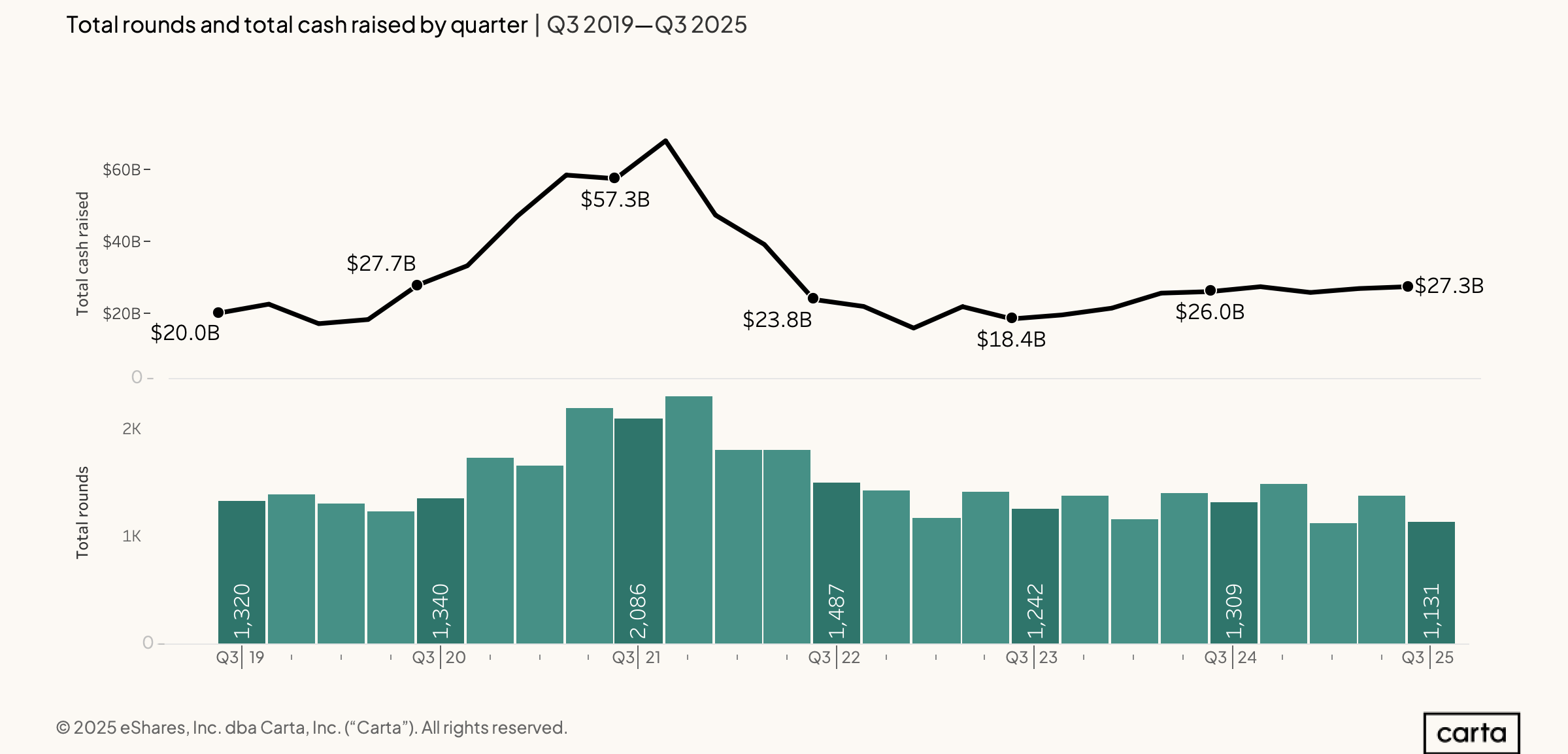
The other impact of this, though, is on start-ups. This matters more than, say, just me, because it ripples out across the ecosystem. For the past few years there has been limited supply and a lot of demand for funding, which means the bar is already higher to get investment. On top of that, your customers, be they enterprise businesses or individual consumers, have slashed their spend due to the harsh economic climate.
Add to this that many start-ups feel very jaded by funds passing on them, giving a reason that is about the start-up, only to find out later that the fund isn’t deploying at all because it hasn’t raised its next fund yet. Only last week, I was explaining this to a start-up founder who was confused by the feedback from a particular fund on why they were passing on her raise; I knew that fund was behind on its own fundraise and that there was no way it was deploying capital right now.
So, for the last few years, funds and startups alike have been under enormous pressure. Everything has felt 10x harder and everyone is fucking tired of it all.
The great redundancy: The jobs market is crashing out
When an investor is not transparent about the reason they pass on your startup, the experience is frustrating, but the outcome is the same. You don’t get the funding, and you move on. It’s different if you’re a job seeker. When a company or recruiter is not forthcoming about the type of contract, the pay, or the fact that there is an internal candidate who is getting the job, the stakes are more personal and that much higher.
If you follow the news at all, you’ll be aware that we are well and truly in the redundancy portion of the job market cycle. Multiple big tech companies have made large cuts and more are expected to follow suit. For the majority of these mass redundancies, the company line is that AI efficiencies have been the driving force, as technology replaces jobs. Many people are sceptical of that reason, me included, as these look much more like typical redundancies driven by the wider economic downturn and where we are in the cycle of the jobs market (over-hiring > normalising > lay-offs). One can only assume the AI explanation is deemed more shareholder-friendly.
Klarna was the early poster child for this trend, claiming that its AI-powered assistant could perform work equivalent to around 700 customer service employees, and projecting that the technology would contribute approximately $40 million in annual profit. They made huge cuts in line with that projection and saw the share price rise considerably as the market responded positively to the efficiencies. The chatbot was great at volume, but satisfaction dropped for cases requiring more nuance, involving upset customers, or needing more complex handling. Klarna is now re-hiring human customer service agents for that team, and the share price is less than half its IPO value.
TechCrunch reported that “tech layoffs hit their highest single month in two years [in May 2026], with nearly 40,000 cuts, and AI was the most-cited reason for layoffs across every industry for the third month running”. Whatever the reason, it’s flooded the market with brilliant, talented people, all looking for a new job.
As you might expect, at a time of mass redundancies, the jobs market is rough too. The uneven supply and demand, the abundance of AI tools across both the recruiter and applicant side, and the high cost of living right now have made it a brutal place. And when people are overwhelmed and trying their best but not getting results, the concepts of transparency and honesty feel less urgent.
Unsurprisingly, many of the worst behaviours I’ve come across online have been around the jobs market because it is so fraught. Every day, I read a new heart-breaking post on Reddit or LinkedIn or whatever platform about a clever, talented, experienced applicant who has applied for hundreds of jobs with no luck. And when I say the job market is rough, it’s hard to understand unless you are actually reading through these posts from candidates, who have applied to hundreds, if not thousands, of jobs over the last year and barely got a response back.
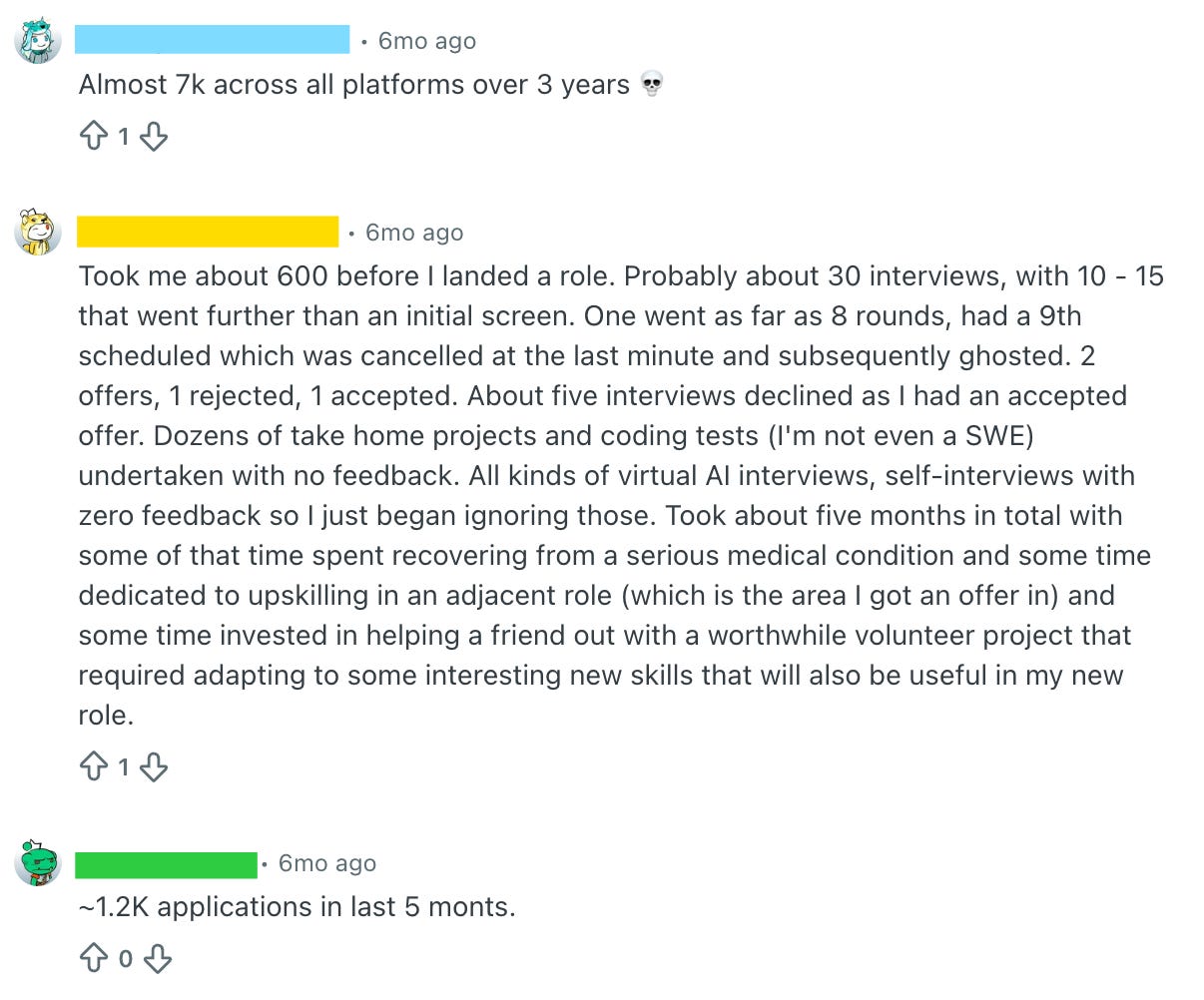
Equally, HR teams are reporting being spammed with thousands of applicants for a single role, many of whom are not even remotely suitable for it. The sheer numbers overwhelm the system and make it nigh on impossible for People teams to give proper care to the candidates who are genuinely qualified. Applicants feel like they’ve been ghosted, or like they’re dealing with yet another bait and switch by a company.
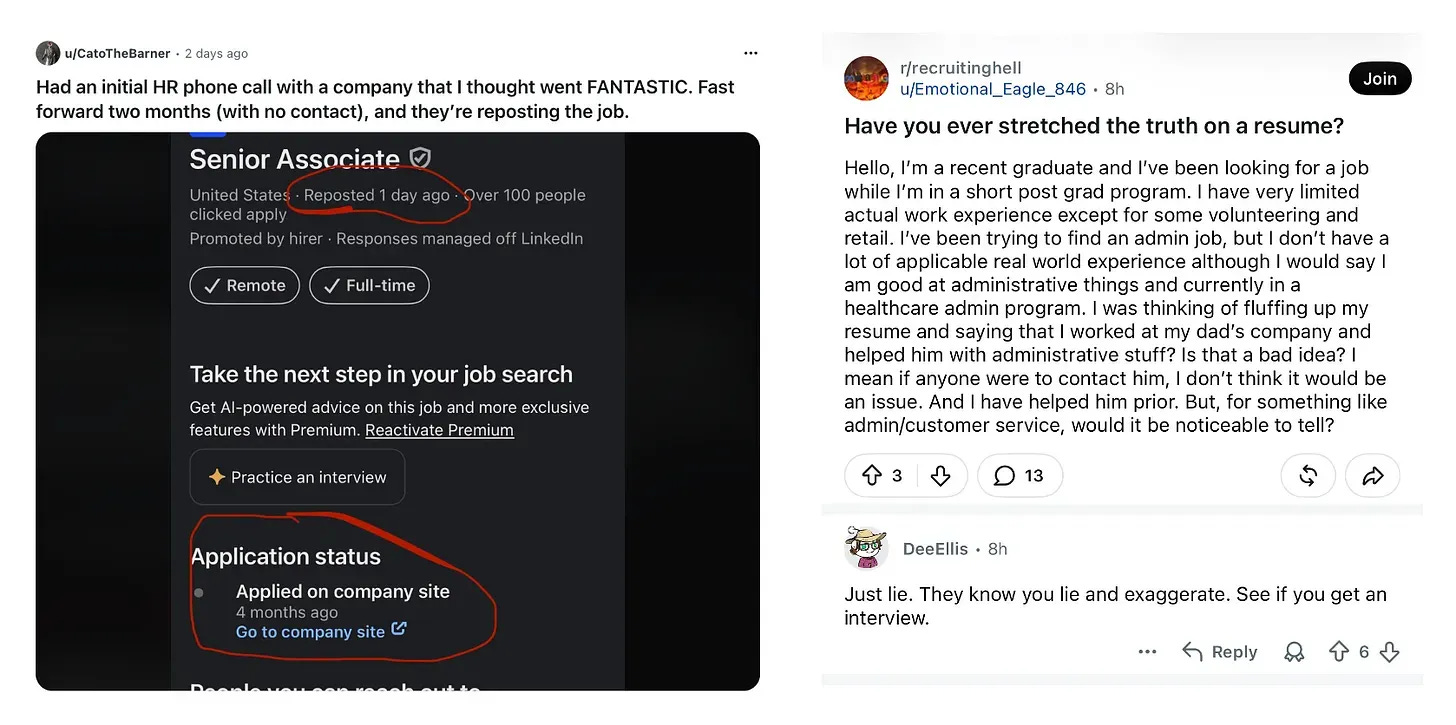
I’m a big believer that our actions are shaped by our environment. It’s hard to be your best self in your worst moments. It’s even harder if your worst moments feel like they’ve stretched on for months, if not years. And few things are harder than worrying about your basic stability and ability to pay the bills, let alone the bigger picture of your career.
Given the rate of redundancies, I personally think that the job market will continue to be tough for the near future. All we can do is give grace where we can, and give ourselves space where we can’t. A turnaround has to come soon, right?
The AI rocket ships: Left behind on the ground
Right now, AI is either stealing your job (see above) or it’s just made your old neighbour a multi-millionaire. As TechCrunch noted, we have “tens of thousands of laid-off workers hitting an unusually unforgiving cost environment at the same time that tens of thousands of AI insiders are seeing once-in-a-generation paper wealth materialise.”
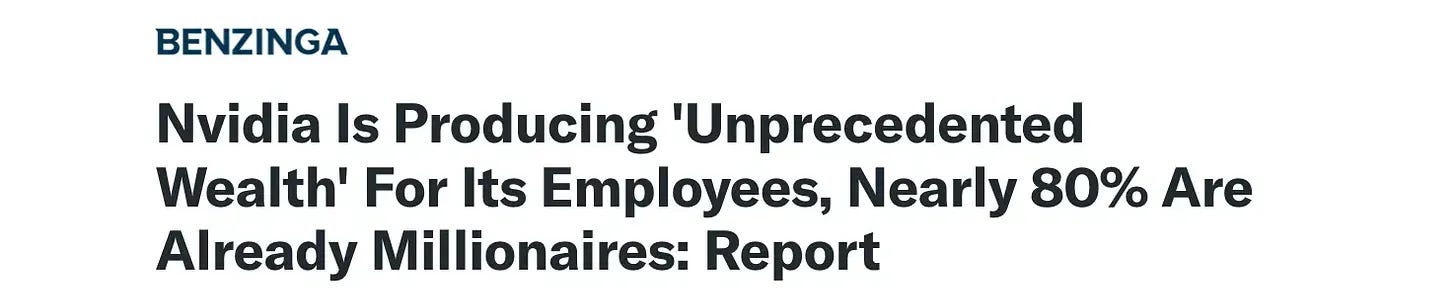
Of course, some of these are well-established companies: OpenAI is over a decade old, and NVIDIA was founded in the 90s, so it’s not unreasonable for them to be hitting this right now. But it’s much harder not to feel envy when the reports are of companies only months old raising massive early numbers time and time again. Picking three Seed rounds from recent headlines: Elorian raised $55 million at a $300 million valuation just months after the founder left Google. There was Thinking Machines’ mind-blowing $2 billion Seed. And, hot off the press, Fish Audio has announced a $52 million Seed to build AI voice models for creators and enterprises. Even the less exceptional AI startups have commanded larger and larger rounds as the norm.
But it’s not just how much they are raising. It’s also the unbelievable rate at which they are growing, at a velocity you wouldn’t have believed a couple of years ago. Fish Audio’s Seed suddenly seems more reasonable when you find out that “since launching last year, the startup now has more than 8 million people using the open source or hosted versions of its models, and generates annual recurring revenue of $21 million.” Fyxer AI scaled from $0 to $17 million ARR in nine months alone. And these are just a couple of examples of the growth that is now the expectation to be an outstanding company.
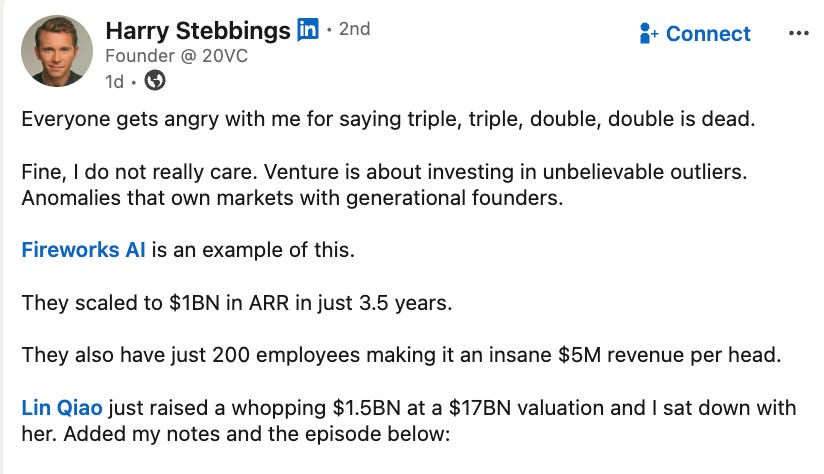
On the one hand, this is all pretty amazing and demonstrates the incredible possibilities that AI has unlocked. But it also unlocks a new level of pressure for the entire ecosystem.
In the past few weeks, Phia, the shopping-tech company, famous for the fact that one of its founders is Bill Gates’ daughter, has fallen foul of an investigation by Bloomberg. The buzzy startup, which has raised over $40 million and is valued at $185 million, was founded by Phoebe Gates and Sophia Kianni. The article alleges that the company has been taking both the credit and commission for sales that it did not generate, a practice known as ‘cookie stuffing’. The company responded that this was a limited codebase issue, which was now fixed.
Could they have done it on purpose to inflate sales? Yes. Could it have been an accident? Also, yes.
But let’s take a step back: we have two founders, 23 and 24 years old, bearing both the weight of the Gates name and the growth expectations that accompany their buzzy and high-profile fundraise. They need to grow - very quickly - and everyone is watching. I don’t know if they did or didn’t do it on purpose, but all I know is that if it were me in that situation, I’m not confident I would have the clearest moral compass under all that pressure.
In a market where $17 million ARR in nine months and $1 billion in under four years become the benchmark, previously respectable numbers start to look like failure. Founders who are doing fine feel like they're dying. So the deck rounds up. The pipeline becomes "revenue". The AI feature becomes "AI-native". Maybe the helpful error in the codebase goes unfixed for a couple of months longer.
None of it starts as a lie. It starts as a comparison.
Ending on a positive
It’s not all bad. At the beginning of this piece, I talked about my frustration at the unnecessary and odd deception I’d come across. There’s a flip side to that. During this same period, I have also worked with and been supported by unbelievable people who went out of their way to be helpful, kind, or make a connection. Lauren, who made an amazing introduction for me, unasked, despite living on different continents and having met only a handful of times. Sam, who recommended me within his company. Jess, who repeatedly shared great opportunities - and many others.
I also know that many of them were dealing with their own complications and trials yet made time, in spite of this. I am in awe of their generosity.
So, if there’s any uplifting ending I can give you here, it’s this: even in the worst of times, there are people who will show you their best. And if it’s your best of times, then give some grace to those on the other side.
Things will get better. Hang tight.